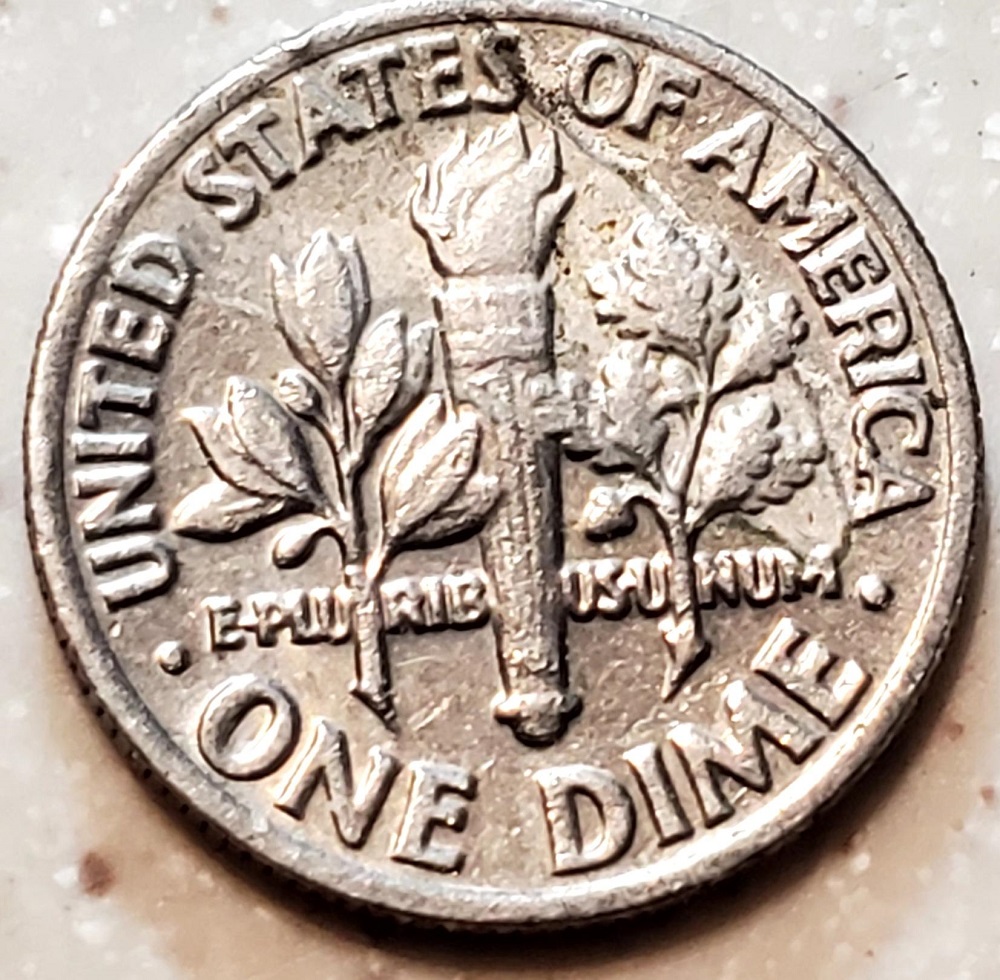
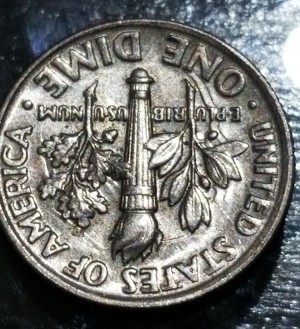
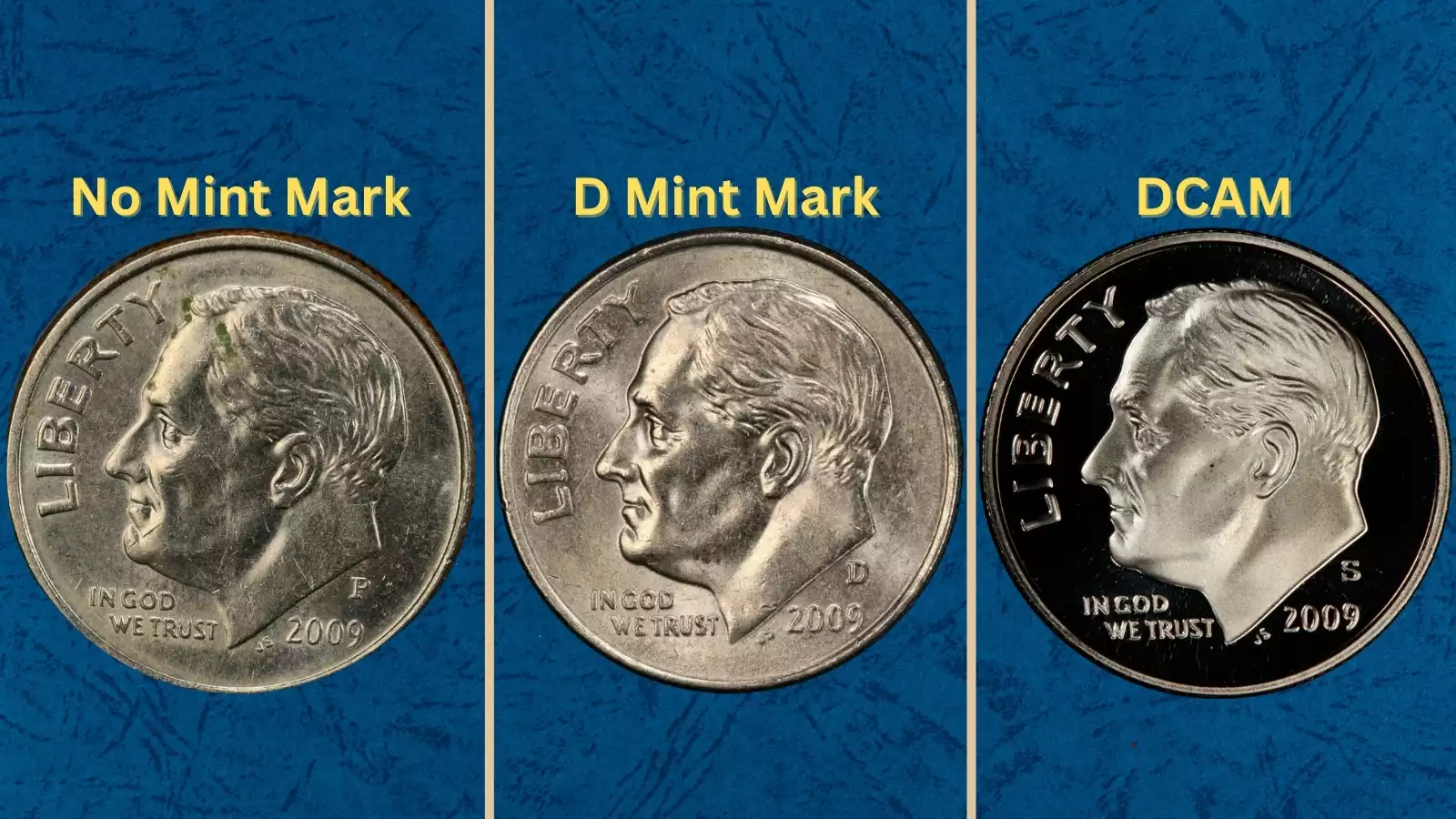
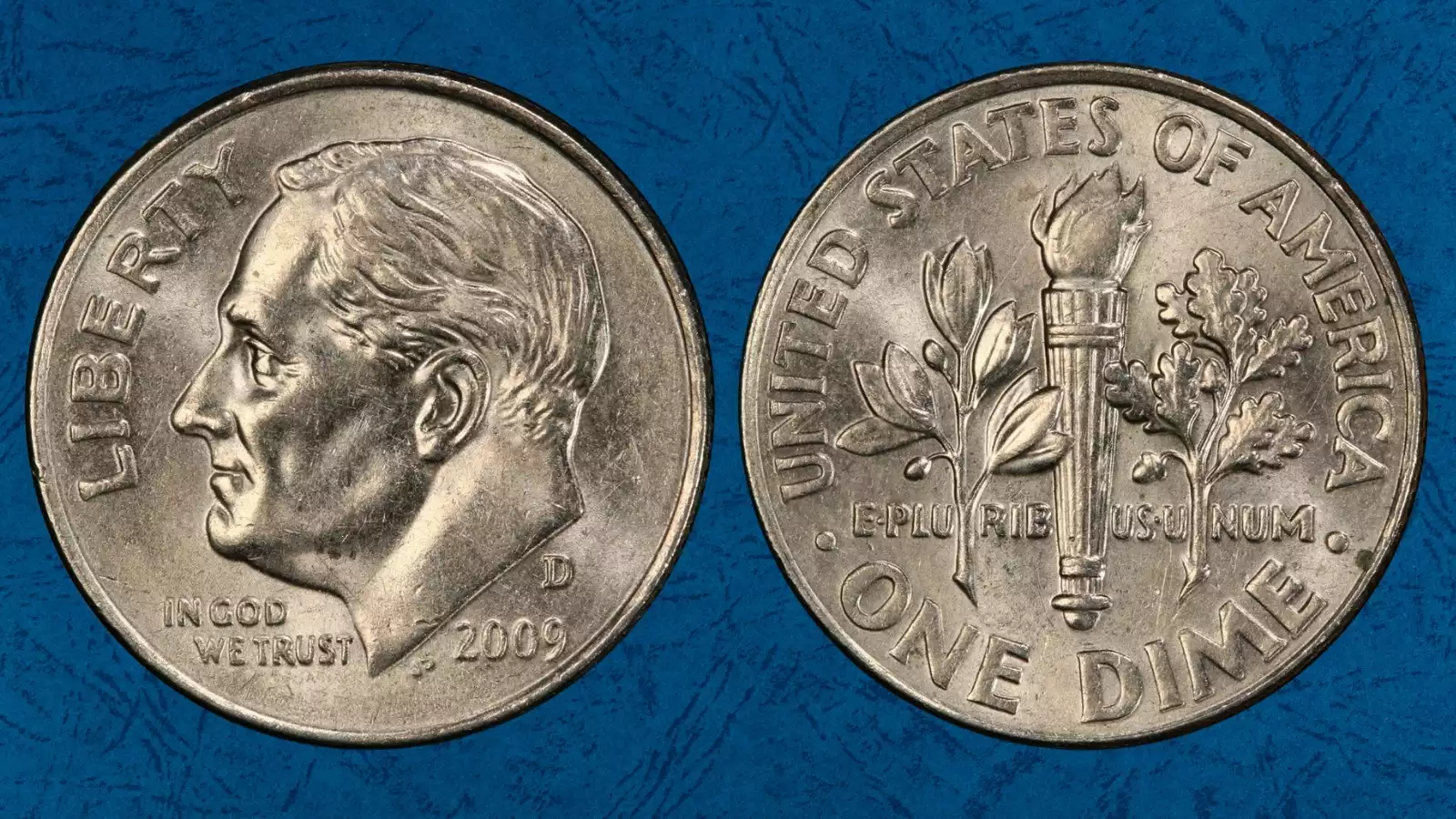
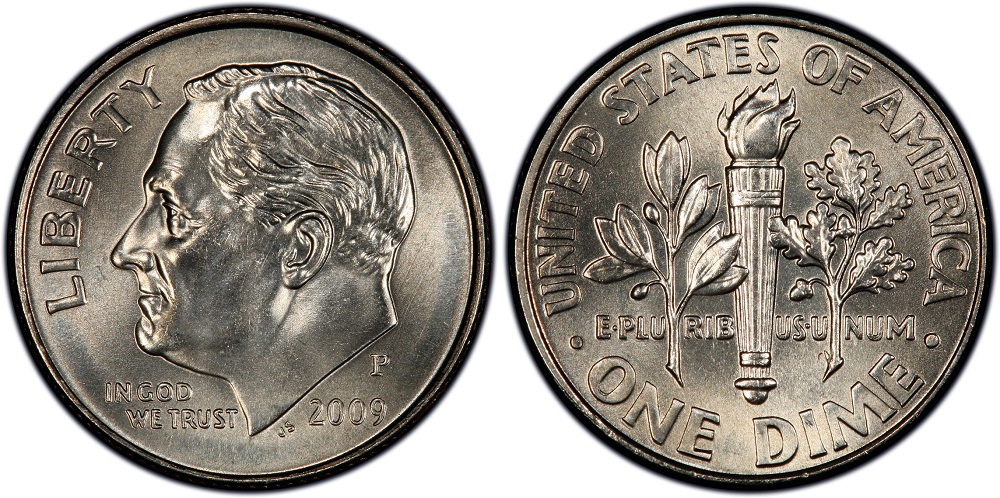
2009-P and 2009-D Roosevelt dimes obverse showing mint marks and date

The Complete Guide to 2009 Dime Value

A 2009-P Roosevelt dime graded MS67 with Full Bands sold for $649 at auction — yet most 2009 dimes in your pocket change are worth only face value. The difference comes down to mint mark, condition, and one critical designation on the reverse torch. With the lowest combined mintage since 1955, the right 2009 dime is a genuine modern rarity.

★★★★★ 4.8 · Rated by 1,247 collectors
Check My 2009 Dime Value →
$649
Top auction record (MS67FB, 2018)
49.5M
2009-D mintage — lowest clad-era Roosevelt dime
86%
Production cut vs. 2008 — recession-driven scarcity
6
Total varieties: P, D, Satin Finish ×2, Clad Proof, Silver Proof

Full Bands Self-Checker: Does Your 2009 Dime Have the Premium Designation?

The Full Bands (FB) designation — or Full Torch (FT) at NGC — is the single biggest value multiplier on a 2009 Roosevelt dime. An MS67 without Full Bands is worth roughly $35; the same coin with Full Bands sold for $649. Use the comparison below and checklist to assess your coin before spending money on grading fees.

2009 Roosevelt dime torch comparison: weak bands left vs fully separated Full Bands right
Common — Standard Strike
No Full Bands designation

The two horizontal bands on the torch appear merged or show only partial separation. This is the majority of 2009 business-strike dimes. In MS65, worth roughly $1–$15. In MS67, still worth only $35–$60 without the designation.

— vs —
Premium — Full Bands (FB) / Full Torch (FT)
Complete band separation across entire torch

Both upper and lower horizontal bands are fully separated with a clear visible gap running the entire width of the torch. NGC's Full Torch additionally requires defined vertical lines on the torch body. Only a small percentage of 2009 dimes qualify — confirmed exclusively by PCGS or NGC certification.

Check all four that apply to your coin:

Describe Your 2009 Dime for a Detailed Assessment

Describe what you see on your coin — mint mark, surface quality, any unusual features, color, or marks. Our keyword analyzer will give you a tailored assessment and guide you toward the right next step.

Mention these things if you can

  • Mint mark (P, D, or S)
  • Whether it looks uncirculated or worn
  • Torch bands — merged or separated?
  • Any doubling on inscriptions
  • Unusual color or surface texture

Also helpful

  • Off-center or misaligned strike?
  • Missing clad layer (copper showing)?
  • Lamination flakes or cracks?
  • Die clash marks (ghosted design)?
  • Any cracks in the die design?

Skipped the calculator? Get a fast value estimate in under 60 seconds.

Use the Calculator →

Free 2009 Dime Value Calculator

Work through three quick steps to get a value estimate based on real market data. Select your options below, then click Calculate.

1
2
3

Step 1 of 3 — Select Mint Mark

The mint mark is on the obverse (heads side) above the date. If there's no visible letter, it's a P (Philadelphia).

Step 2 of 3 — Select Condition

Be honest — graders see overstated grades constantly. When in doubt, select one tier lower.

Step 3 of 3 — Errors & Designations

Check all that apply. If unsure, leave unchecked.

If you're not yet sure about your coin's mint mark or condition, there's a 2009 Dime Coin Value Checker tool that lets you identify the coin from photos before you start.

The Valuable 2009 Dime Errors — Complete Guide

The 2009 date carries a powerful scarcity multiplier for mint errors. Because only 146 million circulation dimes were struck — versus 1.05 billion the year before — errors on 2009-dated dies are far rarer than identical error types on common dates. An off-center 2009 dime can command 14 times more than the same error on a 2007 or 2010 date. Here are the five most significant varieties and errors to know, ranked by documented collector demand.

2009-P Roosevelt dime lamination crack error on obverse showing planchet delamination

Lamination Crack / Peel Error

MOST VALUABLE $400 – $865+

A lamination error occurs when the clad bonding between the outer nickel layer and the copper core fails during or after the minting process. The internal stress causes the surface metal to separate, crack, or peel away from the coin's body — sometimes taking part of the design with it. On 2009 dimes, this defect likely originates from inclusions or voids in the planchet strip, which went undetected during quality control in a year when the Mint was running drastically reduced production schedules.

Visually, lamination cracks appear as irregular crevices or raised lines across the coin's field or devices. Peeled laminations leave a recessed, raw-copper-toned area where the nickel cladding has lifted away. Flap-type laminations — where the separated layer is still partially attached — are especially dramatic and desirable. Unlike post-mint damage, genuine lamination defects have smooth, raised edges consistent with die strike and are fully integrated into the coin's surface topography.

Collector demand for this error type on 2009 dates is well-documented. A 2009-P lamination crack example graded MS63 sold for $865 at Heritage Auctions in 2020, establishing it as the single highest recorded sale for a 2009 dime error. The combination of a dramatic visual impact and the 2009 scarcity multiplier makes this the most sought-after of all 2009 dime errors. PCGS and NGC each certify lamination errors with a qualifying description note on the holder label.

How to spot it

Under a 10× loupe, look for irregular cracks, raised edges, or lifting flaps of metal on the coin's surface. Genuine laminations have smooth, internally consistent edges; post-mint damage from scraping will show sharp, bright metal with no surface integration.

Mint mark

P (Philadelphia) most documented; D (Denver) examples also exist. Both mint marks carry the same scarcity premium.

Notable

A 2009-P MS63 lamination crack example sold for $865 at Heritage Auctions in 2020 — the highest confirmed auction result for any 2009 dime error. PCGS and NGC certify these with a qualifying note on the holder.

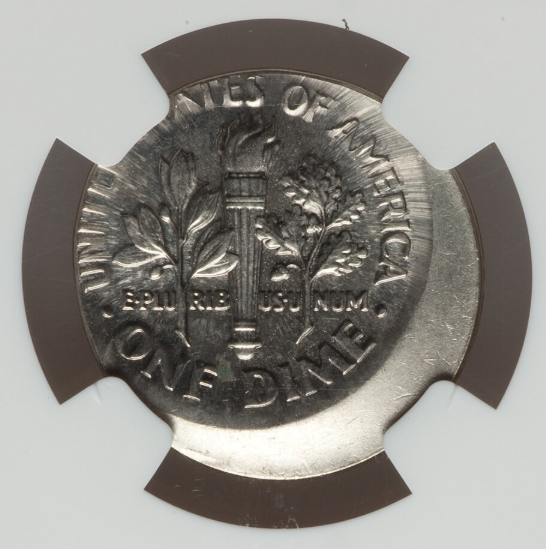
2009 Roosevelt dime off-center strike error with visible blank crescent and date intact

Off-Center Strike Error

MOST FAMOUS $200 – $1,000+

An off-center strike occurs when the planchet is not properly centered beneath the die pair at the moment of striking, leaving part of the design unstruck and a crescent of blank, unstruck planchet visible at one side of the coin. The collar die — which normally holds the planchet in precise alignment — either fails to fully engage or the blank shifts position before the strike. The result is one of the most visually striking and immediately recognizable mint errors in the hobby.

For a 2009 dime off-center error to have significant collector value, the date must remain visible. This confirms the coin's identity and prevents it from being confused with a plain planchet. Minor off-center strikes in the 5–15% range on 2009-P or 2009-D dimes are valued at $400–$500. Major off-center strikes in the 40–60% range — where nearly half the design is absent but the date is still legible — can command $600–$1,000 or more due to extreme scarcity at that severity level on a low-mintage date.

The 2009 scarcity multiplier is most dramatic here. PCGS auction records show a 5% off-center 2009 dime bringing around $420, versus a comparable error on a common date bringing roughly $31 — a 14-fold difference driven entirely by the low 2009 mintage. This effect makes 2009 off-center strikes among the most compelling modern error investments, with values likely to increase as the low-mintage story becomes more widely understood among modern coin collectors.

How to spot it

Look for a blank, raised rim-free crescent of unstruck planchet on one side of the coin. The design will be shifted toward the opposite side. Check with a loupe that the date remains fully or partially visible — this is essential for premium value attribution.

Mint mark

P (Philadelphia) and D (Denver) business strikes only. The 2009-D carries a stronger premium at equivalent off-center percentage due to lower mintage.

Notable

Minor off-center examples (5–15%) have sold for $400–$500; major strikes (40–60% off-center with date visible) could realize $600–$1,000+. The scarcity multiplier effect is ~14× versus common-date equivalents per comparative PCGS auction data.

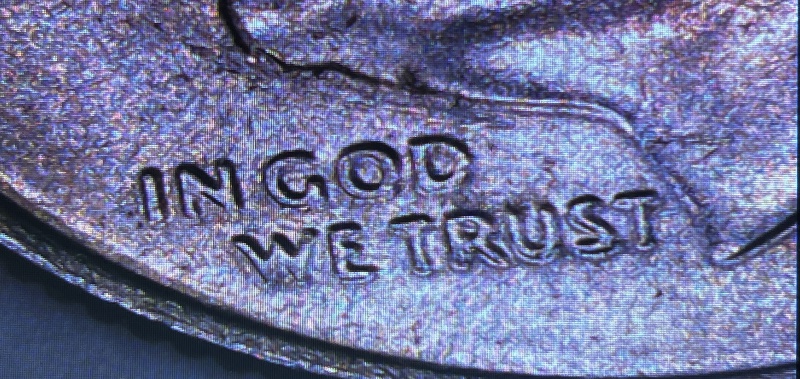
2009-D Roosevelt dime doubled die obverse error showing doubling on LIBERTY and date

Doubled Die Obverse (DDO) Error

RAREST $150 – $600+

A Doubled Die Obverse occurs when the working die receives two or more misaligned impressions from the hub during the hubbing process, imparting a double image into the die itself. This is a true die error — every coin struck from that die will carry the doubling, making it a recognized variety rather than a one-off mechanical mistake. On the 2009-D Roosevelt dime, this error manifests primarily on the obverse, with doubling visible on the LIBERTY inscription, the date digits, or IN GOD WE TRUST.

The visual signature of a genuine DDO on the 2009 dime is flat, shelf-like doubling — a raised, secondary image of the letters or digits that appears at a slight offset from the primary impression. This is distinct from machine doubling damage (MDD), which creates flat, shelf-like steps without the raised secondary design elements. Under a 10× loupe, true DDO doubling will show a clearly raised secondary image with its own detail and depth; machine doubling will appear as a flat, smeared shadow.

The 2009-D DDO is a documented variety, though population data in certified holders remains thin due to the overall scarcity of high-grade 2009-D business strikes. Collector value is driven both by the doubled die designation and by the underlying rarity of the 2009-D date in MS64+ condition. Examples graded MS64 with confirmed doubling have sold in the $150–$600 range, with premium prices achievable for boldly doubled specimens where the shift is visible without magnification to a trained eye.

How to spot it

Examine LIBERTY, IN GOD WE TRUST, and the date digits under a 10× loupe with good side lighting. Look for a raised, clearly defined secondary image offset from the primary — not a flat smear, which indicates common machine doubling damage with no value premium.

Mint mark

D (Denver) is the documented die; P (Philadelphia) examples may also exist. Both business-strike mints only — this error does not apply to proof or satin finish issues.

Notable

The 2009-D MS64 Obverse Doubled Die has sold in the $150–$600 range based on comparable auction data. Confirmation by PCGS or NGC is essential — machine doubling damage is frequently mislabeled as a DDO by inexperienced sellers online.

2009-P Roosevelt dime die clash error showing ghost reverse design elements on the obverse field

Die Clash Error

BEST KEPT SECRET $200 – $500+

A die clash error occurs when the obverse and reverse dies strike against each other without a planchet positioned between them. The collision imprints a mirror image of each die's design into the face of the opposing die — the obverse die picks up a negative impression of the reverse design, and vice versa. When these clashed dies subsequently strike coins, the ghosted design elements appear in the fields of the resulting coins, sometimes overlapping the primary design in striking and visible ways.

On the 2009 Roosevelt dime, die clash evidence typically appears as faint ghost outlines of the reverse torch, olive branch, or oak branch elements in the obverse field, or as residual imagery of Roosevelt's portrait appearing in the reverse field near the torch and branches. The degree of clash severity — which depends on how hard the dies struck each other and how many planchets were struck on the clashed dies before they were caught and replaced — determines the visual intensity and thus the collector premium.

Die clash errors on 2009 dimes have sold for approximately $390 on eBay and at similar online venues for mid-grade examples, with stronger specimens realizing $500 or more at established auction venues. The combination of a visually compelling ghosted design, the 2009 low-mintage story, and the inherent interest of die errors among modern coin collectors drives active demand. Professional authentication is critical — surface contact marks can occasionally mimic the appearance of ghost imagery to an untrained eye.

How to spot it

Under a 10× loupe, examine the obverse field near Roosevelt's face for faint outlines of the torch or branches. Check the reverse field near the torch base for ghosted portrait lines. Ghost imagery will be relief-positive and show consistent depth across the field under raking light.

Mint mark

P (Philadelphia) most commonly documented; D (Denver) examples also exist. Both mint marks eligible for the error designation.

Notable

Die clash examples on 2009 dimes have sold for approximately $390 on eBay for mid-grade business strikes. Stronger clashes with bold ghost imagery can bring $500 or more at named auction venues like GreatCollections or Heritage Auctions.

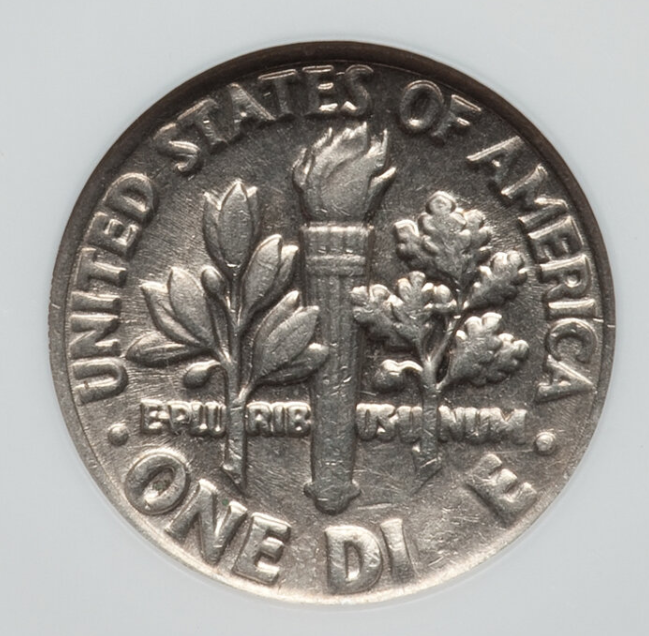
2009-D Roosevelt dime grease struck-through error showing flat missing design area from die grease fill

Grease Struck-Through Error

CONDITION RARITY $150 – $500+

A grease struck-through error occurs when accumulated die grease, metal filings, or other foreign material fills one or more cavities in the working die. When the die strikes the planchet, the obstruction prevents metal from fully flowing into the filled cavity — resulting in one or more areas of the design that appear flat, weakly impressed, or entirely missing, while the surrounding details remain well-struck. This differs from a weak strike, where overall pressure is insufficient, because only the obstructed area is affected.

On the 2009 dime, grease struck-through errors most commonly affect the obverse lettering, the date, or the reverse inscriptions where fine die cavities are most susceptible to grease accumulation. The flat or missing area will have a smooth, planchet-level surface without the raised detail of a normally struck coin. Unlike a worn die, which produces uniformly soft details across the entire design, a genuine struck-through will show sharp detail immediately adjacent to the flat area, making the obstruction immediately apparent under magnification.

Collector demand for this error type is driven by the visual drama of the missing or flat design element combined with the sharp surrounding detail — the juxtaposition makes the error undeniable and educational. A 2009-D dime graded MS64 with an obverse grease struck-through sold for $420 on eBay in 2020, demonstrating active market demand. The 2009 date premium applies here as it does to other errors, with comparable errors on common dates commanding a fraction of this price.
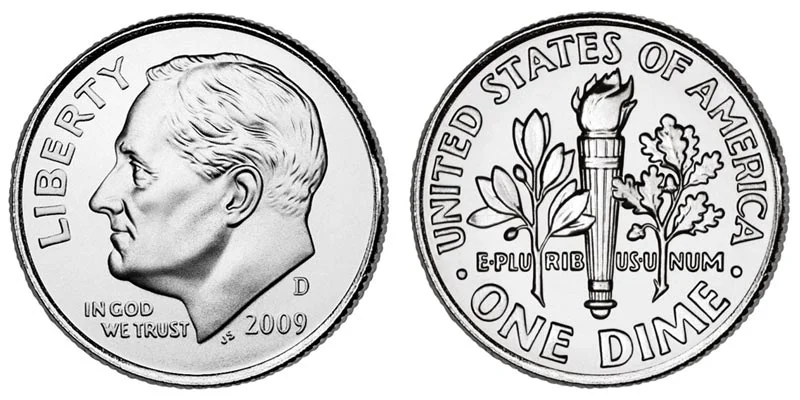
How to spot it

Look for a localized flat or missing area within an otherwise well-struck coin. The flat zone will have no raised detail and a smooth, planchet-level surface. Adjacent design elements will be sharp and clear — ruling out overall die weakness or strike softness as explanations.

Mint mark

D (Denver) is the best-documented source for this error on 2009 dimes; P (Philadelphia) examples have also been observed. Both business-strike mints eligible.

Notable

A 2009-D MS64 grease struck-through error sold for $420 on eBay in 2020. Professional authentication is essential — weak strike areas from die wear can superficially resemble this error but carry no premium value.

Think you've spotted one of these errors on your coin? Get a value estimate with the calculator.

Calculate Error Value →

2009 Dime Value Chart at a Glance

Values below reflect 2025–2026 market conditions based on PCGS and NGC auction data. For an in-depth look at each variety's identification points, see this illustrated 2009 dime identification breakdown and reference guide. The 2009-D Full Bands row is highlighted — it represents the strongest value multiplier in the entire series. The rarest top-pop designation row is marked in orange-red.

Variety Worn (G–VF) Circulated (EF–AU) Uncirculated (MS63–65) Gem (MS66–68+)
2009-P Business Strike $0.15 – $0.35 $0.50 – $1.50 $4 – $15 $20 – $60
2009-P Full Bands (FB) $0.30 – $0.50 $1 – $3 $10 – $40 $60 – $649
2009-D Business Strike $0.20 – $0.35 $0.75 – $2 $5 – $20 $25 – $100
⭐ 2009-D Full Bands (FB) $0.30 – $0.50 $1 – $3 $15 – $35 $100 – $350+
2009-P / -D Satin Finish $5 – $12 (SP67) $18 – $50 (SP69FB)
2009-S Clad Proof $6 – $15 (PR69–70 DCAM)
🔴 2009-S Silver Proof $7 – $38 (PR69–70 DCAM)

⭐ Gold = Signature variety (highest demand). 🔴 Orange-red = Highest premium at gem grade (silver composition). Values are market estimates; certified coins may realize higher prices.

📱 CoinKnow lets you verify a 2009 dime's estimated value in seconds by entering the mint mark and grade from your phone — a coin identifier and value app.

2009 Dime Mintage & Survival Data

Group of 2009 Roosevelt dimes from multiple mint facilities showing range of conditions
Issue Mint Mintage Type Notes
2009-P Philadelphia 96,500,000 Business Strike Most common 2009 business strike; not included in standard Mint Sets
2009-D Denver 49,500,000 Business Strike Lowest clad-era circulation Roosevelt dime mintage; not in 2009 Mint Sets
2009-P SMS Philadelphia ~784,614 sets Satin Finish / Specimen Sold in 2009 Uncirculated Mint Set only; distinctive matte surface
2009-D SMS Denver ~784,614 sets Satin Finish / Specimen Denver counterpart of Mint Set satin issue; typical grades SP67–SP68
2009-S Proof San Francisco 1,482,502 Clad Proof Included in 2009 Clad Proof Set; Deep Cameo finish
2009-S Silver Proof San Francisco 697,365 Silver Proof (90% Ag) Sold in 2009 Silver Proof Set; 90% silver, 10% copper composition
Totals ~146M circulation + ~4.6M collector Combined lowest circulation mintage since 1955
Composition Specs: Business strike and satin finish — 91.67% copper, 8.33% nickel (copper core bonded to nickel outer layers). Silver proof — 90% silver, 10% copper. Weight: 2.27 g (business/satin), 2.50 g (silver proof). Diameter: 17.9 mm. Edge: Reeded. Designer: John R. Sinnock (both obverse and reverse). Obverse: Left-facing Roosevelt portrait with LIBERTY, IN GOD WE TRUST, date, and mint mark. Reverse: Torch flanked by olive branch (left) and oak branch (right); E PLURIBUS UNUM; UNITED STATES OF AMERICA; ONE DIME.

How to Grade Your 2009 Roosevelt Dime

Grading a 2009 Roosevelt dime correctly is the single most important step before selling or submitting to a grading service. The difference between MS65 and MS67 with Full Bands can mean the difference between a $10 coin and a $150+ coin.

2009 Roosevelt dime grading strip showing four condition tiers from Worn G4 to Gem MS67
Tier 1

Worn (Good–Very Fine)

Roosevelt's portrait shows clear flattening on the cheekbone and hair above the ear. The torch flame is weak and details merge. Rim is mostly intact but may be worn flat on the high points. All major lettering readable. Worth face value ($0.10) to roughly $0.35.

Tier 2

Lightly Used (EF–AU)

High points show slight wear — Roosevelt's cheekbone, the hair above the ear, and the top of the torch flame may have slight flatness. Luster is mostly gone in worn areas but may be present in protected low areas. Worth $0.50–$2.00 depending on eye appeal.

Tier 3

Uncirculated (MS60–65)

No trace of wear. Original mint luster present across the entire surface. Contact marks from bag handling are expected and acceptable at lower MS grades. Eye appeal and strike quality determine the grade within this range. MS65 gem examples trade around $1–$15.

Tier 4

Gem (MS66–MS68+)

Strong, unbroken luster. Surfaces are clean with only minimal, non-distracting marks. At MS67+, marks must be nearly absent. The Full Bands designation requires complete separation of the torch's horizontal bands — the difference between a $60 coin and a $649 coin at MS67.

💡 Pro Tip — Strike & Full Bands: The 2009-D business strike is especially susceptible to weak strikes because the Mint was running reduced press speeds during the economic crisis. Even nominally uncirculated 2009-D dimes frequently fail to achieve the Full Bands designation. When evaluating your coin, always examine the torch bands first under a 10× loupe before assessing grade — a weakly struck MS66 may be worth $20, while a sharply struck MS66FB can be worth $60 or more.

🔎 CoinKnow helps you match your coin's surfaces against graded examples to cross-check your condition assessment before submission — a coin identifier and value app.

Where to Sell Your Valuable 2009 Roosevelt Dime

Where you sell depends on the coin's value tier. A circulated dime is fine for a local coin shop. A certified MS67FB example belongs in a competitive auction where collectors bid against each other.

🏆 Heritage Auctions

The best venue for certified, high-grade 2009 dimes in MS66+ or with confirmed error designations. Heritage reaches a global collector base and achieves competitive hammer prices for modern condition rarities. Submit through their website; consignment minimums may apply for lower-value lots.

🛒 eBay

The largest marketplace for certified and raw coins at all price points. Browse recently sold prices for 2009-P dimes on eBay listings and comps to set a competitive asking price. Certified PCGS/NGC holders sell significantly faster and at stronger prices than raw coins. Use "Buy It Now" for common examples; auction format for error coins or high-grade examples above $100.

🏪 Local Coin Shop (LCS)

Best for quick cash on circulated or common uncirculated examples where you don't need top dollar. Local dealers offer convenience and immediate payment but typically pay 50–70% of retail value. Call ahead — not all shops are actively buying modern Roosevelt dimes, especially in circulated condition.

👥 Reddit (r/Coins4Sale)

An excellent peer-to-peer option for collectors selling directly to other collectors. Lower fees than eBay and an engaged, knowledgeable buyer base. Post clear photos under good lighting. Best for mid-range certified coins in the $20–$200 range; major error coins are better served by Heritage or GreatCollections.

🔐 Get It Graded First — Is It Worth It?

For any 2009 business-strike dime that appears uncirculated with possible Full Bands, or any coin showing a clear mint error, PCGS or NGC grading is strongly recommended. The $20–$30 grading fee is justified whenever the coin might grade MS66+ or carry an error designation. A raw, ungraded 2009-D that might be MS67FB will sell for $50–$80 online; the same coin in a PCGS or NGC holder can realize $200–$350+. For circulated or average uncirculated coins, grading costs exceed potential value gains — skip it for those.

Frequently Asked Questions — 2009 Dime Value

How much is a 2009 dime worth?
Most circulated 2009 dimes are worth face value—$0.10. Uncirculated business strikes in MS65 grade fetch around $1–$2. The 2009-D is worth more in high grades due to its record-low 49.5 million mintage. At the top of the market, an MS67FB example sold for $649. Error coins can be worth several hundred dollars or more depending on type and severity.
What makes the 2009-D dime special?
The 2009-D Roosevelt dime has the lowest mintage of any clad-era circulation-strike Roosevelt dime, with only 49,500,000 produced. The 2009-D was also not included in the standard Mint Sets for that year, meaning fewer pristine, carefully preserved examples exist. This scarcity makes it a significant modern rarity, especially in grades above MS67 with the Full Bands designation.
What is the Full Bands (FB) designation?
Full Bands (FB) is a PCGS strike-quality designation for Roosevelt dimes where the two horizontal bands on the reverse torch are fully and cleanly separated. NGC calls this Full Torch (FT) and additionally requires defined vertical lines on the torch body. This designation can multiply a coin's value several times over—a 2009-P MS67 without FB is worth around $60, while the same coin with FB sold for $649.
Why were 2009 dimes minted in such small numbers?
The 2008–2009 financial crisis caused the Federal Reserve to drastically cut coin orders. A massive surplus of circulating coins had built up, and with reduced economic activity, demand for new coins collapsed. The US Mint halted dime production mid-year in 2009, resulting in just 146 million dimes total—an 86% reduction from the 1.05 billion struck in 2008 and the lowest combined dime mintage since 1955.
What is the auction record for a 2009 dime?
The confirmed auction record for a 2009-P Roosevelt dime is $649.42, achieved on eBay on June 25, 2018, for a PCGS-graded MS67FB specimen. This grade represents the top of the certified population for Philadelphia business strikes, with only two examples known in MS68FB as of 2025. The 2009-D business strike in comparable top grades commands similarly strong premiums.
What 2009 dime errors are most valuable?
The most valuable documented 2009 dime errors include: a lamination crack error that sold for $865 at Heritage Auctions; a feeder finger scrapes error that brought $615 at GreatCollections; and a grease struck-through error graded MS64 that sold for $420 on eBay. Off-center strikes (40–60% off-center with visible date) can fetch $200 or more. Die clash errors have sold for around $390. Always seek PCGS or NGC certification before selling.
Is a 2009-P or 2009-D dime more valuable?
In circulated condition, both are worth about $0.10 face value. In high uncirculated grades, the 2009-D generally commands a stronger premium due to its much lower mintage (49.5 million vs. 96.5 million for the P). However, the single confirmed auction record of $649 belongs to a 2009-P MS67FB. For MS67+ with Full Bands, values for both are similar; below MS67, the 2009-D commands the stronger premium per coin.
What are the 2009 dime satin finish coins?
The 2009-P and 2009-D satin finish (or Specimen Strike/SMS) dimes were struck exclusively for the 2009 Uncirculated Mint Set. They have a distinctive matte-satin surface unlike business strikes or proofs. Because they were carefully handled and packaged, most grade SP67 or better. Satin finish examples trade for roughly $5–$50 depending on grade and Full Bands status. They are collector-only coins, not released into circulation.
How do I check if my 2009 dime has Full Bands?
Examine the torch on the reverse under a 10× loupe or strong magnification. Look for two distinct horizontal bands wrapped around the torch's midsection. If both bands show a clear gap between them with no merging, your coin may qualify for Full Bands (PCGS) or Full Torch (NGC). The bands must show complete separation across the entire width of the torch. Only PCGS or NGC certification can officially confirm this designation.
Should I clean my 2009 dime before selling it?
Never clean a coin before selling or submitting it for grading. Cleaning—even gentle wiping—destroys the original mint luster and leaves hairline scratches visible under magnification. This causes significant grade deductions and can make a potentially MS67 coin grade as low as AU58 or lower. PCGS and NGC will identify cleaned coins and label them as 'details' grades, dramatically reducing their market value. Preserve coins as-is, stored in proper holders.

Ready to find out what your 2009 dime is worth?

Use the free calculator — takes under 60 seconds. No signup required.

Check My 2009 Dime Value →